291. Electron gain enthalpy with negative sign of fluorine is less than that of chlorine due to :
A
High ionization enthalpy of fluorine
B
Smaller size of chlorine atom
C
Smaller size of fluorine atom
D
Bigger size of $$2p$$ orbital of fluorine
Answer :
Smaller size of fluorine atom
292. Lead is not affected by $$dil.\,HCl$$ in cold because
A
$$Pb$$ is less electronegative than $$H$$
B
$$PbO$$ film is formed which resists chemical attack by acid
C
$$PbC{l_2}$$ protective coating gets formed on $$Pb$$ surface
D
$$Pb{O_2}$$ film is always present on $$Pb$$ surface, which resist chemical attack
Answer :
$$PbC{l_2}$$ protective coating gets formed on $$Pb$$ surface
293. Which one of the following species is not a pseudohalide?
A
$$CN{O^ - }$$
B
$$RCO{O^ - }$$
C
$$OC{N^ - }$$
D
$$NN{N^ - }$$
Answer :
$$RCO{O^ - }$$
294. Aluminium exhibits + 3 oxidation state. As we move down the group, + 1 oxidation state gets more stable. This is a consequence of
A
increasing size of the atom
B
inert pair effect
C
electron deficient nature
D
$$p\pi - p\pi $$ bonding
Answer :
inert pair effect
295. $$N{a_2}{B_4}{O_7} + X \to {H_3}B{O_3}.$$ What is $$X$$ in the reaction?
A
Aqueous solution of $$NaOH$$
B
Dilute nitric acid
C
Cone. $${H_2}S{O_4}$$ or $$HCl$$
D
Water
Answer :
Cone. $${H_2}S{O_4}$$ or $$HCl$$
297. The molecule having smallest bond angle is :
A
$$NC{l_3}$$
B
$$AsC{l_3}$$
C
$$SbC{l_3}\,$$
D
$$PC{l_3}$$
Answer :
$$SbC{l_3}\,$$
298. One mole of calcium phosphide on reaction with excess of water gives
A
one mole of phosphine.
B
two moles of phosphoric acid.
C
two moles of phosphine.
D
one mole of phosphorus oxide.
Answer :
two moles of phosphine.
299. The most stable form of carbon at high temperature is $$X.$$ The $$C-C$$ bond length in diamond is $$Y$$ while $$C-C$$ bond length in graphite is $$Z.$$ What are $$X, Y$$ and $$Z$$ respectively?
A
$${\text{Graphite,}}\,{\text{1}}{\text{.42}}\,\mathop {\text{A}}\limits^{\text{o}} ,1.54\mathop {\,{\text{A}}}\limits^{\text{o}} $$
B
$${\text{Coke,}}\,1.54\mathop {\,{\text{A}}}\limits^{\text{o}} ,1.84\,\mathop {\text{A}}\limits^{\text{o}} $$
C
$${\text{Diamond,}}\,1.54\,\mathop {\text{A}}\limits^{\text{o}} ,1.42\,\mathop {\text{A}}\limits^{\text{o}} $$
D
$${\text{Fullerene,}}\,1.54\mathop {\,{\text{A}}}\limits^{\text{o}} ,1.54\,\mathop {\text{A}}\limits^{\text{o}} $$
Answer :
$${\text{Diamond,}}\,1.54\,\mathop {\text{A}}\limits^{\text{o}} ,1.42\,\mathop {\text{A}}\limits^{\text{o}} $$
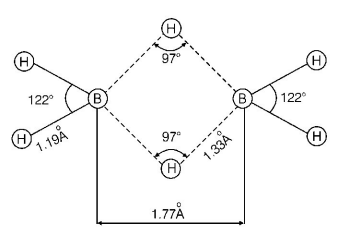
300. Which of the following is the electron deficient molecule?
A
$${B_2}{H_6}$$
B
$${C_2}{H_6}$$
C
$$P{H_3}$$
D
$$Si{H_4}$$
Answer :
$${B_2}{H_6}$$