Question

Which of the following will give a pair of enantiomers ? $$\left( {en = N{H_2}C{H_2}C{H_2}N{H_2}} \right)$$

A. $$\left[ {Cr{{\left( {N{H_3}} \right)}_6}} \right]\left[ {Co{{\left( {CN} \right)}_6}} \right]$$
B. $$\left[ {Co{{\left( {en} \right)}_2}C{l_2}} \right]Cl$$  
C. $$\left[ {Pt{{\left( {N{H_3}} \right)}_4}} \right]\left[ {PtC{l_6}} \right]$$
D. $$\left[ {Co{{\left( {N{H_3}} \right)}_4}C{l_2}} \right]N{O_2}$$
Answer :   $$\left[ {Co{{\left( {en} \right)}_2}C{l_2}} \right]Cl$$
Solution :
Enantiomorphs or Enantiomers A pair of molecules related to each other as an object and its mirror images are known as enantiomorphs or enantiomers. These are not superimposable on its mirror image.
The example is $${\left[ {Co{{\left( {en} \right)}_2}C{l_2}} \right]^ + }$$
Dichlorobis ( ethylene diamine ) cobalt (III)
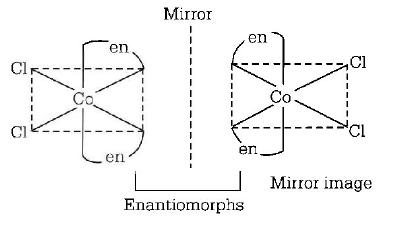
Co-ordination Compounds mcq solution image

Releted MCQ Question on
Inorganic Chemistry >> Co - ordination Compounds

Releted Question 1

Amongst $$Ni{\left( {CO} \right)_4},{\left[ {Ni{{\left( {CN} \right)}_4}} \right]^{2 - }}{\text{and}}\,NiCl_4^{2 - }$$

A. $$Ni{\left( {CO} \right)_4}\,{\text{and}}\,NiCl_4^{2 - }$$     are diamagnetic and $${\left[ {Ni{{\left( {CN} \right)}_4}} \right]^{2 - }}$$   is paramagnetic
B. $$NiCl_4^{2 - }\,{\text{and}}\,{\left[ {Ni{{\left( {CN} \right)}_4}} \right]^{2 - }}$$     are diamagnetic and $$Ni{\left( {CO} \right)_4}$$   is paramagnetic
C. $$Ni{\left( {CO} \right)_4}\,{\text{and}}\,{\left[ {Ni{{\left( {CN} \right)}_4}} \right]^{2 - }}$$     are diamagnetic and $$NiCl_4^{2 - }$$  is paramagnetic
D. $$Ni{\left( {CO} \right)_4}$$  is diamagnetic and $$NiCl_4^{2 - }\,{\text{and}}\,{\left[ {Ni{{\left( {CN} \right)}_4}} \right]^{2 - }}$$     are paramagnetic
Releted Question 2

The geometry of $$Ni{\left( {CO} \right)_4}\,{\text{and}}\,Ni{\left( {PP{h_3}} \right)_2}C{l_2}\,{\text{are}}$$

A. both square planar
B. tetrahedral and square planar, respectively
C. both tetrahedral
D. square planar and tetrahedral, respectively
Releted Question 3

The complex ion which has no $$'d'$$ electron in the central metal atom is

A. $${\left[ {Mn{O_4}} \right]^ - }$$
B. $${\left[ {Co{{\left( {N{H_3}} \right)}_6}} \right]^{3 + }}$$
C. $${\left[ {Fe{{\left( {CN} \right)}_6}} \right]^{3 - }}$$
D. $${\left[ {Cr{{\left( {{H_2}O} \right)}_6}} \right]^{3 + }}$$
Releted Question 4

In the process of extraction of gold,
Roasted gold ore $$ + C{N^ - } + {H_2}O\mathop \to \limits^{{O_2}} \left[ X \right] + O{H^ - }$$
$$\left[ X \right] + Zn \to \left[ Y \right] + Au$$
Identify the complexes $$\left[ X \right]\,\,{\text{and}}\,\,\left[ Y \right]$$

A. $$X = {\left[ {Au{{\left( {CN} \right)}_2}} \right]^ - },Y = {\left[ {Zn{{\left( {CN} \right)}_4}} \right]^{2 - }}$$
B. $$X = {\left[ {Au{{\left( {CN} \right)}_4}} \right]^{3 - }},Y = {\left[ {Zn{{\left( {CN} \right)}_4}} \right]^{2 - }}$$
C. $$X = {\left[ {Au{{\left( {CN} \right)}_2}} \right]^ - },Y = {\left[ {Zn{{\left( {CN} \right)}_6}} \right]^{4 - }}$$
D. $$X = {\left[ {Au{{\left( {CN} \right)}_4}} \right]^ - },Y = {\left[ {Zn{{\left( {CN} \right)}_4}} \right]^{2 - }}$$

Practice More Releted MCQ Question on
Co - ordination Compounds


Practice More MCQ Question on Chemistry Section