Question

What is the correct order of decreasing stability of the following cations?
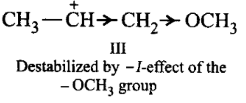
$$\eqalign{ & \mathop {C{H_3} - \mathop C\limits^ + H - C{H_3}}\limits_{\left( {\text{I}} \right)} \cr & \mathop {C{H_3} - \mathop C\limits^ + H - OC{H_3}}\limits_{\left( {{\text{II}}} \right)} \cr & \mathop {C{H_3} - \mathop C\limits^ + H - C{H_2} - OC{H_3}}\limits_{\left( {{\text{III}}} \right)} \cr} $$

A. (II) > (I) > (III)  
B. (II) > (III) > (I)
C. (III) > (I) > (II)
D. (I) > (II) > (III)
Answer :   (II) > (I) > (III)
Solution :
General Organic Chemistry mcq solution image
Thus, the stability of carbocations decreases in the order : II > I > III.

Releted MCQ Question on
Organic Chemistry >> General Organic Chemistry

Releted Question 1

The bond order of individual carbon-carbon bonds in benzene is

A. one
B. two
C. between one and two
D. one and two alternately
Releted Question 2

Molecule in which the distance between the two adjacent carbon atoms is largest is

A. Ethane
B. Ethene
C. Ethyne
D. Benzene
Releted Question 3

Among the following, the compound that can be most readily sulphonated is

A. benzene
B. nitrobenzene
C. toluene
D. chlorobenzene
Releted Question 4

The compound 1, 2-butadiene has

A. only $$sp$$   hybridized carbon atoms
B. only $$s{p^2}$$ hybridized carbon atoms
C. both $$sp$$  and $$s{p^2}$$ hybridized carbon atoms
D. $$sp$$ , $$s{p^2}$$ and $$s{p^3}$$ hybridized carbon atoms

Practice More Releted MCQ Question on
General Organic Chemistry


Practice More MCQ Question on Chemistry Section