Question
The existence of two different coloured complexes with the composition of $${\left[ {Co{{\left( {N{H_3}} \right)}_4}C{l_2}} \right]^ + }$$ is due to
A.
linkage isomerism
B.
geometrical isomerism
C.
coordination isomerism
D.
ionisation isomerism
Answer :
geometrical isomerism
Solution :
Key Idea Complexes of $$\left[ {M{A_4}{B_2}} \right]$$ type exhibit geometrical isomerism.
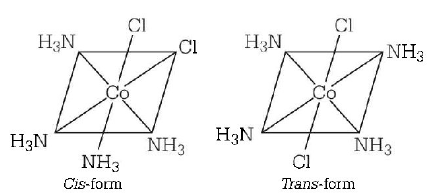
The complex $${\left[ {Co{{\left( {N{H_3}} \right)}_4}C{l_2}} \right]^ + }$$ is a $$\left[ {M{A_4}{B_2}} \right]$$ type complex and thus, fulfills the conditions that are necessary to exhibit geometrical isomerism. Hence, it has two geometrical isomers of different colours as : The structure of the geometrical isomers is as
For linkage isomerism, presence of ambidentate ligand is necessary.
For coordination isomerism, both the cation and anion of the complex must be complex ions.
For ionisation isomerism, an anion different to the ligands must be present outside the coordination sphere. All these conditions are not satisfied by this complex. Hence, it does not exhibit other given isomerisms.
Key Idea Complexes of $$\left[ {M{A_4}{B_2}} \right]$$ type exhibit geometrical isomerism.
The complex $${\left[ {Co{{\left( {N{H_3}} \right)}_4}C{l_2}} \right]^ + }$$ is a $$\left[ {M{A_4}{B_2}} \right]$$ type complex and thus, fulfills the conditions that are necessary to exhibit geometrical isomerism. Hence, it has two geometrical isomers of different colours as : The structure of the geometrical isomers is as
For linkage isomerism, presence of ambidentate ligand is necessary.
For coordination isomerism, both the cation and anion of the complex must be complex ions.
For ionisation isomerism, an anion different to the ligands must be present outside the coordination sphere. All these conditions are not satisfied by this complex. Hence, it does not exhibit other given isomerisms.