Question
The addition of $$HBr$$ to 1-butene gives a mixture of products (I), (II) and (III) :
The addition of $$HBr$$ to 1-butene gives a mixture of products (I), (II) and (III) :
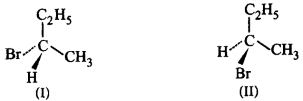
$$\mathop {C{H_3} - C{H_2} - C{H_2} - C{H_2} - Br}\limits_{\left( {{\text{III}}} \right)} $$
The mixture consists of
A.
(I) and (II) as major and (III) as minor products
B.
(II) as major, (I) and (III) as minor products
C.
(II) as minor, (I) and (III) as major products
D.
(I) and (II) as minor and (III) as major products
Answer :
(I) and (II) as major and (III) as minor products
Solution :
\[\underset{\text{1-Butene}}{\mathop{C{{H}_{3}}C{{H}_{2}}-CH=C{{H}_{2}}}}\,\xrightarrow[\begin{smallmatrix} \text{Markovnikov}\,\text{ }\!\!'\!\!\text{ }\,\text{s} \\ \text{addition} \end{smallmatrix}]{HBr}\] \[\underset{\begin{smallmatrix} \text{(exists in 2 enantiomers I and II)} \\ \text{(Major product) } \end{smallmatrix}}{\mathop{C{{H}_{3}}C{{H}_{2}}\underset{\begin{smallmatrix} |\,\,\,\,\, \\ Br\,\,\,\,\, \end{smallmatrix}}{\overset{*\,\,\,\,\,}{\mathop{-CH-}}}\,C{{H}_{3}}}}\,+\] \[\underset{\text{III (Minor product)}}{\mathop{C{{H}_{3}}C{{H}_{2}}C{{H}_{2}}C{{H}_{2}}Br}}\,\]
\[\underset{\text{1-Butene}}{\mathop{C{{H}_{3}}C{{H}_{2}}-CH=C{{H}_{2}}}}\,\xrightarrow[\begin{smallmatrix} \text{Markovnikov}\,\text{ }\!\!'\!\!\text{ }\,\text{s} \\ \text{addition} \end{smallmatrix}]{HBr}\] \[\underset{\begin{smallmatrix} \text{(exists in 2 enantiomers I and II)} \\ \text{(Major product) } \end{smallmatrix}}{\mathop{C{{H}_{3}}C{{H}_{2}}\underset{\begin{smallmatrix} |\,\,\,\,\, \\ Br\,\,\,\,\, \end{smallmatrix}}{\overset{*\,\,\,\,\,}{\mathop{-CH-}}}\,C{{H}_{3}}}}\,+\] \[\underset{\text{III (Minor product)}}{\mathop{C{{H}_{3}}C{{H}_{2}}C{{H}_{2}}C{{H}_{2}}Br}}\,\]