81. The density of newly discovered planet is twice that of the earth. The acceleration due to gravity at the surface of the planet is equal to that at the surface of the earth. If the radius of the earth is $$R,$$ the radius of the planet would be
A
$$2R$$
B
$$4R$$
C
$$\frac{1}{4}R$$
D
$$\frac{1}{2}R$$
Answer :
$$\frac{1}{2}R$$
82.
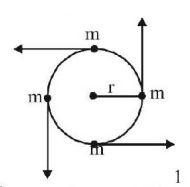
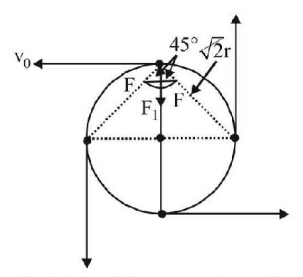
Four similar particles of mass $$m$$ are orbiting in a circle of radius $$r$$ in the same angular direction because of their mutual gravitational attractive force. Then, velocity of a particle is given by
A
$${\left[ {\frac{{Gm}}{r}\left( {\frac{{1 + 2\sqrt 2 }}{4}} \right)} \right]^{\frac{1}{2}}}$$
B
$$\sqrt {\frac{{Gm}}{r}} $$
C
$$\sqrt {\frac{{Gm}}{r}\left( {1 + 2\sqrt 2 } \right)} $$
D
$${\left[ {\frac{1}{2}\frac{{Gm}}{r}\left( {\frac{{1 + 2\sqrt 2 }}{4}} \right)} \right]^{\frac{1}{2}}}$$
Answer :
$${\left[ {\frac{{Gm}}{r}\left( {\frac{{1 + 2\sqrt 2 }}{4}} \right)} \right]^{\frac{1}{2}}}$$
83. The potential energy of a rock, having mass $$m$$ and rotating at a height of $$3.2 \times {10^6}m$$ from the earth surface, is
A
$$ - 6\,mg{R_e}$$
B
$$ - 0.67\,mg{R_e}$$
C
$$ - 0.99\,mg{R_e}$$
D
$$ - 0.33\,mg{R_e}$$
Answer :
$$ - 0.67\,mg{R_e}$$
84. The period of moon's rotation around the earth is nearly 29 days. If moon's mass were 2 fold its present value and all other things remain unchanged, the period of moon's rotation would be nearly
A
$$29\sqrt 2 \,{\text{days}}$$
B
$$\frac{{29}}{{\sqrt 2 }}\,{\text{days}}$$
C
$$29 \times 2\,{\text{days}}$$
D
$$29\,{\text{days}}$$
Answer :
$$29\,{\text{days}}$$
85. The radii of two planets are respectively $${R_1}$$ and $${R_2}$$ and their densities are respectively $${\rho _1}$$ and $${\rho _2}.$$ The ratio of the accelerations due to gravity at their surfaces is
A
$${g_1}:{g_2} = \frac{{{\rho _1}}}{{R_1^2}}:\frac{{{\rho _2}}}{{R_2^2}}$$
B
$${g_1}:{g_2} = {R_1}{R_2}:{\rho _1}{\rho _2}$$
C
$${g_1}:{g_2} = {R_1}{R_2}:{R_2}{\rho _1}$$
D
$${g_1}:{g_2} = {R_1}{\rho _1}:{R_2}{\rho _2}$$
Answer :
$${g_1}:{g_2} = {R_1}{\rho _1}:{R_2}{\rho _2}$$
86.
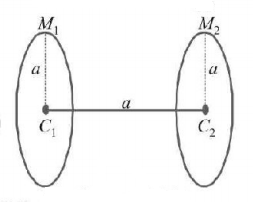
Two rings each of radius $$'a'$$ are coaxial and the distance between their centres is $$a.$$ The masses of the rings are $${M_1}$$ and $${M_2}.$$ The work done in transporting a particle of a small mass $$m$$ from centre $${C_1}$$ to $${C_2}$$ is :
A
$$\frac{{Gm\left( {{M_2} - {M_1}} \right)}}{a}$$
B
$$\frac{{Gm\left( {{M_2} - {M_1}} \right)}}{{a\sqrt 2 }}\left( {\sqrt 2 + 1} \right)$$
C
$$\frac{{Gm\left( {{M_2} - {M_1}} \right)}}{{a\sqrt 2 }}\left( {\sqrt 2 - 1} \right)$$
D
$$\frac{{Gm\left( {{M_2} - {M_1}} \right)}}{{\sqrt 2 }}a$$
Answer :
$$\frac{{Gm\left( {{M_2} - {M_1}} \right)}}{{a\sqrt 2 }}\left( {\sqrt 2 - 1} \right)$$
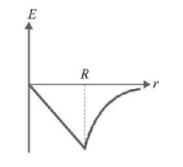
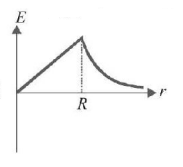
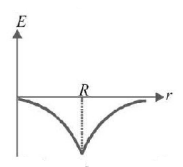
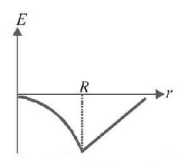
87. The gravitational field strength due to a solid sphere (mass $$M,$$ radius $$R$$ ) varies with distance $$r$$ from centre as
A
B
C
D
Answer :
88. A satellite $$S$$ is moving in an elliptical orbit around the earth. The mass of the satellite is very small as compared to the mass of the earth. Then,
A
the angular momentum of $$S$$ about the centre of the earth changes in direction, but its magnitude remains constant
B
the total mechanical energy of $$S$$ varies periodically with time
C
the linear momentum of $$S$$ remains constant in magnitude
D
the acceleration of $$S$$ is always directed towards the centre of the earth
Answer :
the acceleration of $$S$$ is always directed towards the centre of the earth
89. The acceleration due to gravity at a height $$1\,km$$ above the earth is the same as at a depth $$d$$ below the surface of earth. Then
A
$$d = \frac{1}{2}km$$
B
$$d = 1\,km$$
C
$$d = \frac{3}{2}km$$
D
$$d = 2\,km$$
Answer :
$$d = 2\,km$$
90. Infinite number of bodies, each of mass $$2\,kg$$ are situated on $$X$$-axis at distances $$1\,m,2\,m, 4\,m$$ and $$8\,m,$$ respectively from the origin. The resulting gravitational potential due to this system at the origin will be
A
$$ - G$$
B
$$ - \frac{8}{3}G$$
C
$$ - \frac{4}{3}G$$
D
$$ - 4G$$
Answer :
$$ - 4G$$