Question

Consider the following complex ions, $$P,Q$$  and $$R.$$
$$P = {\left[ {Fe{F_6}} \right]^{3 - }},Q = {\left[ {V{{\left( {{H_2}O} \right)}_6}} \right]^{2 + }}{\text{and}}\,R = {\left[ {Fe{{\left( {{H_2}O} \right)}_6}} \right]^{2 + }}$$
The correct order of the complex ions, according to their spin-only magnetic moment values $$\left( {{\text{in}}\,{\text{B}}{\text{.M}}.} \right)$$  is

A. $$R < Q < P$$
B. $$Q < R < P$$  
C. $$R < P < Q$$
D. $$Q < P < R$$
Answer :   $$Q < R < P$$
Solution :
The electronic configuration of central metal ion in complex ions $$P,Q\,{\text{and}}\,R$$   are
$$P = {\left[ {Fe{F_6}} \right]^{3 - }};F{e^{3 + }}:$$     Co-ordination Compounds mcq solution image
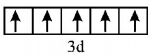
$$Q = {\left[ {V{{\left( {{H_2}O} \right)}_6}} \right]^{2 + }};{V^{2 + }}$$     Co-ordination Compounds mcq solution image
$$R = {\left[ {Fe{{\left( {{H_2}O} \right)}_6}} \right]^{2 + }};F{e^{2 + }}$$     Co-ordination Compounds mcq solution image
Higher the no. of unpaired electron(s), higher will be magnetic moment. Thus the correct order of spin only magnetic moment is $$Q < R < P$$

Releted MCQ Question on
Inorganic Chemistry >> Co - ordination Compounds

Releted Question 1

Amongst $$Ni{\left( {CO} \right)_4},{\left[ {Ni{{\left( {CN} \right)}_4}} \right]^{2 - }}{\text{and}}\,NiCl_4^{2 - }$$

A. $$Ni{\left( {CO} \right)_4}\,{\text{and}}\,NiCl_4^{2 - }$$     are diamagnetic and $${\left[ {Ni{{\left( {CN} \right)}_4}} \right]^{2 - }}$$   is paramagnetic
B. $$NiCl_4^{2 - }\,{\text{and}}\,{\left[ {Ni{{\left( {CN} \right)}_4}} \right]^{2 - }}$$     are diamagnetic and $$Ni{\left( {CO} \right)_4}$$   is paramagnetic
C. $$Ni{\left( {CO} \right)_4}\,{\text{and}}\,{\left[ {Ni{{\left( {CN} \right)}_4}} \right]^{2 - }}$$     are diamagnetic and $$NiCl_4^{2 - }$$  is paramagnetic
D. $$Ni{\left( {CO} \right)_4}$$  is diamagnetic and $$NiCl_4^{2 - }\,{\text{and}}\,{\left[ {Ni{{\left( {CN} \right)}_4}} \right]^{2 - }}$$     are paramagnetic
Releted Question 2

The geometry of $$Ni{\left( {CO} \right)_4}\,{\text{and}}\,Ni{\left( {PP{h_3}} \right)_2}C{l_2}\,{\text{are}}$$

A. both square planar
B. tetrahedral and square planar, respectively
C. both tetrahedral
D. square planar and tetrahedral, respectively
Releted Question 3

The complex ion which has no $$'d'$$ electron in the central metal atom is

A. $${\left[ {Mn{O_4}} \right]^ - }$$
B. $${\left[ {Co{{\left( {N{H_3}} \right)}_6}} \right]^{3 + }}$$
C. $${\left[ {Fe{{\left( {CN} \right)}_6}} \right]^{3 - }}$$
D. $${\left[ {Cr{{\left( {{H_2}O} \right)}_6}} \right]^{3 + }}$$
Releted Question 4

In the process of extraction of gold,
Roasted gold ore $$ + C{N^ - } + {H_2}O\mathop \to \limits^{{O_2}} \left[ X \right] + O{H^ - }$$
$$\left[ X \right] + Zn \to \left[ Y \right] + Au$$
Identify the complexes $$\left[ X \right]\,\,{\text{and}}\,\,\left[ Y \right]$$

A. $$X = {\left[ {Au{{\left( {CN} \right)}_2}} \right]^ - },Y = {\left[ {Zn{{\left( {CN} \right)}_4}} \right]^{2 - }}$$
B. $$X = {\left[ {Au{{\left( {CN} \right)}_4}} \right]^{3 - }},Y = {\left[ {Zn{{\left( {CN} \right)}_4}} \right]^{2 - }}$$
C. $$X = {\left[ {Au{{\left( {CN} \right)}_2}} \right]^ - },Y = {\left[ {Zn{{\left( {CN} \right)}_6}} \right]^{4 - }}$$
D. $$X = {\left[ {Au{{\left( {CN} \right)}_4}} \right]^ - },Y = {\left[ {Zn{{\left( {CN} \right)}_4}} \right]^{2 - }}$$

Practice More Releted MCQ Question on
Co - ordination Compounds


Practice More MCQ Question on Chemistry Section