Question

Compounds $$(A)$$  and $$(C)$$  in the following reactions are
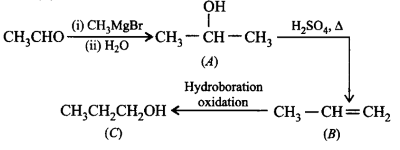
\[C{H_3}CHO\xrightarrow[{\left( {{\text{ii}}} \right)\,{H_2}O}]{{\left( {\text{i}} \right)\,C{H_3}MgBr}}\left( A \right)\]      \[\xrightarrow{{{H_2}S{O_4},\,\Delta }}\left( B \right)\]   \[\xrightarrow{{{\text{Hydroboration oxidation}}}}\left( C \right)\]

A. identical
B. positional isomers  
C. functional isomers
D. optical isomers
Answer :   positional isomers
Solution :
Aldehyde and Ketone mcq solution image

Releted MCQ Question on
Organic Chemistry >> Aldehyde and Ketone

Releted Question 1

The reagent with which both acetaldehyde and acetone react easily is

A. Fehling’s reagent
B. Grignard reagent
C. Schiff’s reagent
D. Tollen’s reagent
Releted Question 2

The Cannizzaro reaction is not given by

A. trimethylacetaldehye
B. acetaldehyde
C. benzaldehyde
D. formaldehyde
Releted Question 3

The compound that will not give iodoform on treatment with alkali and iodine is :

A. acetone
B. ethanol
C. diethyl ketone
D. isopropyl alcohol
Releted Question 4

Polarisation of electrons in acrolein may be written as

A. $$\mathop {C{H_2}}\limits^{{\delta ^ - }} = CH - \mathop {CH}\limits^{{\delta ^ + }} = O$$
B. $$\mathop {C{H_2}}\limits^{{\delta ^ - }} = CH - CH = \mathop O\limits^{{\delta ^ + }} $$
C. $$\mathop {C{H_2}}\limits^{{\delta ^ - }} = \mathop {CH}\limits^{{\delta ^ + }} - CH = O$$
D. $$\mathop {C{H_2}}\limits^{{\delta ^ + }} = CH - CH = \mathop O\limits^{{\delta ^ - }} $$

Practice More Releted MCQ Question on
Aldehyde and Ketone


Practice More MCQ Question on Chemistry Section