Question

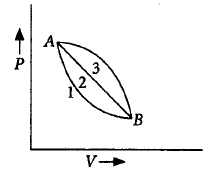
A given mass of gas expands from state $$A$$  to state $$B$$  by three paths 1, 2, and 3 as shown in the figure :
Chemical Thermodynamics mcq question image
If $${w_1},{w_2}$$  and $${w_3}$$ respectively, be the work done by the gas along three paths, then

A. $${w_1} > {w_2} > {w_3}$$
B. $${w_1} < {w_2} < {w_3}$$  
C. $${w_1} = {w_2} = {w_3}$$
D. $${w_2} > {w_1} > {w_3}$$
Answer :   $${w_1} < {w_2} < {w_3}$$
Solution :
Work is equal to area under $$P - V$$   graph ( when $$P$$  is plotted along $$y$$ - axis ). As area under graph 3 is maximum and area under graph 1 is minimum, so $${w_3}$$  is minimum and $${w_1}$$  is minimum.
$$\therefore \,\,{w_1} < {w_2} < {w_3}$$
Chemical Thermodynamics mcq solution image

Releted MCQ Question on
Physical Chemistry >> Chemical Thermodynamics

Releted Question 1

The difference between heats of reaction at constant pressure and constant volume for the reaction : $$2{C_6}{H_6}\left( l \right) + 15{O_{2\left( g \right)}} \to $$     $$12C{O_2}\left( g \right) + 6{H_2}O\left( l \right)$$     at $${25^ \circ }C$$  in $$kJ$$ is

A. $$-$$ 7.43
B. $$+$$ 3.72
C. $$-$$ 3.72
D. $$+$$ 7.43
Releted Question 2

For which change $$\Delta H \ne \Delta E\,:$$

A. $${H_{2\left( g \right)}} + {I_{2\left( g \right)}} \to 2HI\left( g \right)$$
B. $$HC{\text{l}} + NaOH \to NaC{\text{l}}$$
C. $${C_{\left( s \right)}} + {O_{{2_{\left( g \right)}}}} \to C{o_{{2_{\left( g \right)}}}}$$
D. $${N_2}\left( g \right) + 3{H_2}\left( g \right) \to 2N{H_3}\left( g \right)$$
Releted Question 3

$${\text{The}}\,\Delta H_f^0\,{\text{for}}\,C{O_2}\left( g \right),\,CO\left( g \right)\,$$     and $${H_2}O\left( g \right)$$   are $$-393.5,$$  $$-110.5$$  and $$ - 241.8\,kJ\,mo{l^{ - 1}}$$    respectively. The standard enthalpy change ( in $$kJ$$ ) for the reaction $$C{O_2}\left( g \right) + {H_2}\left( g \right) \to CO\left( g \right) + {H_2}O\left( g \right)\,{\text{is}}$$

A. 524.1
B. 41.2
C. -262.5
D. -41.2
Releted Question 4

In thermodynamics, a process is called reversible when

A. surroundings and system change into each other.
B. there is no boundary between system and surroundings.
C. the surroundings are always in equilibrium with the system.
D. the system changes into the surroundings spontaneously.

Practice More Releted MCQ Question on
Chemical Thermodynamics


Practice More MCQ Question on Chemistry Section