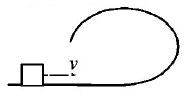
11. A small block is shot into each of the four tracks as shown below. Each of the tracks rises to the same height. The speed with which the block enters the track is the same in all cases. At the highest point of the track, the normal reaction is maximum in
A

B

C
D

Answer :
12.
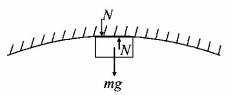
An aircraft executes a horizontal loop with a speed of $$150\,m/s$$ with its wings banked at an angle of $${12^ \circ }.$$ The radius of the loop is :
$$\left( {g = 10\,m/{s^2}} \right)$$
A
$$10.6\,km$$
B
$$9.6\,km$$
C
$$7.4\,km$$
D
$$5.8\,km$$
Answer :
$$10.6\,km$$
13.
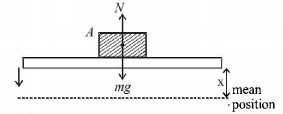
A block $$P$$ of mass $$m$$ is placed on a horizontal frictionless plane. A second block of same mass $$m$$ is placed on it and is connected to a spring of spring constant $$k,$$ the two blocks are pulled by distance $$A.$$ Block $$Q$$ oscillates without slipping. What is the maximum value of frictional force between the two blocks.

A
$$\frac{{kA}}{2}$$
B
$$kA$$
C
$${\mu _s}mg$$
D
zero
Answer :
$$\frac{{kA}}{2}$$
14.
A particle is moving along a circular path in the $$xy$$ plane (see figure). When it crosses the $$x$$-axis, it has an acceleration along the path of $$1.5\,m/{s^2},$$ and is moving with a speed of $$10\,m/s$$ in the negative $$y$$-direction. The total acceleration of the particle is :

A
$$50\,\hat i - 1.5\,\hat j\,m/{s^2}$$
B
$$ - 50\,\hat i - 1.5\,\hat j\,m/{s^2}$$
C
$$10\,\,\hat i - 1.5\,\hat j\,m/{s^2}$$
D
$$1.5\,\hat i - 50\,\hat j\,m/{s^2}$$
Answer :
$$ - 50\,\hat i - 1.5\,\hat j\,m/{s^2}$$
15. A particle tied to a string describes a vertical circular motion of radius $$r$$ continually. If it has a velocity $$\sqrt {3gr} $$ at the highest point, then the ratio of the respective tensions in the string holding it at the highest and lowest points is
A
$$4:3$$
B
$$5:4$$
C
$$1:4$$
D
$$3:2$$
Answer :
$$1:4$$
16. A particle rests on the top of a hemisphere of radius $$R.$$ Find the smallest horizontal velocity that must be imparted to the particle if it is to leave the hemisphere without sliding down is
A
$$\sqrt {gR} $$
B
$$\sqrt {2gR} $$
C
$$\sqrt {3gR} $$
D
$$\sqrt {5gR} $$
Answer :
$$\sqrt {gR} $$
17.
A conical pendulum of length $$1\,m$$ makes an angle $$\theta = {45^ \circ }$$ w.r.t. $$Z$$-axis and moves in a circle in the $$XY$$ plane. The radius of the circle is $$0.4\,m$$ and its centre is vertically below $$O.$$ The speed of the pendulum, in its circular path, will be:
(Take $$g = 10\,m{s^{ - 2}}$$ )

A
$$0.4\,m/s$$
B
$$4\,m/s$$
C
$$0.2\,m/s$$
D
$$2\,m/s$$
Answer :
$$2\,m/s$$

18.
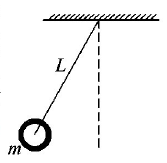
A ball of mass $$\left( m \right) 0.5kg$$ is attached to the end of a string having length $$\left( L \right)\,0.5m.$$ The ball is rotated on a horizontal circular path about vertical axis. The maximum tension that the string can bear is $$324N.$$ The maximum possible value of angular velocity of ball (in radian/s) is
A
9
B
18
C
27
D
36
Answer :
36

19. An annular ring with inner and outer radii $${R_1}$$ and $${R_2}$$ is rolling without slipping with a uniform angular speed. The ratio of the forces experienced by the two particles situated on the inner and outer parts of the ring, $$\frac{{{F_1}}}{{{F_2}}}$$ is
A
$${\left( {\frac{{{R_1}}}{{{R_2}}}} \right)^2}$$
B
$$\frac{{{R_2}}}{{{R_1}}}$$
C
$$\frac{{{R_1}}}{{{R_2}}}$$
D
1
Answer :
$$\frac{{{R_1}}}{{{R_2}}}$$
20. A coin is placed on a horizontal platform which undergoes vertical simple harmonic motion of angular frequency $$\omega .$$ The amplitude of oscillation is gradually increased. The coin will leave contact with the platform for the first time
A
at the mean position of the platform
B
for an amplitude of $$\frac{g}{{{\omega ^2}}}$$
C
for an amplitude of $$\frac{{{g^2}}}{{{\omega ^2}}}$$
D
at the highest position of the platform
Answer :
for an amplitude of $$\frac{g}{{{\omega ^2}}}$$