Question
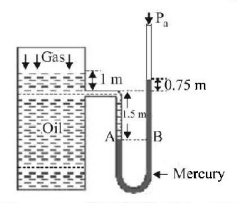
What is the absolute pressure of the gas above the liquid surface in the tank shown in fig. Density of oil $$ = 820\,kg/{m^3},$$ density of mercury $$ = 13.6 \times {10^3}\,kg/{m^3}.$$ Given 1 atmospheric pressure $$ = 1.01 \times {10^5}\,N/{m^2}.$$
What is the absolute pressure of the gas above the liquid surface in the tank shown in fig. Density of oil $$ = 820\,kg/{m^3},$$ density of mercury $$ = 13.6 \times {10^3}\,kg/{m^3}.$$ Given 1 atmospheric pressure $$ = 1.01 \times {10^5}\,N/{m^2}.$$
A.
$$3.81 \times {10^5}\,N/{m^2}$$
B.
$$6 \times {10^6}\,N/{m^2}$$
C.
$$5 \times {10^7}\,N/{m^2}$$
D.
$$4.6 \times {10^2}\,N/{m^2}$$
Answer :
$$3.81 \times {10^5}\,N/{m^2}$$
Solution :
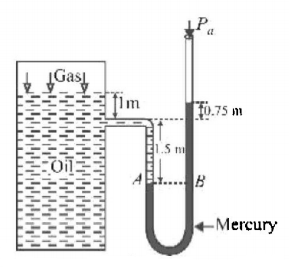
Suppose $${P_{{\text{gas}}}}$$ is the pressure of the gas on the oil. As the points $$A$$ and $$B$$ are at the same level in the mercury columns, so
$$\eqalign{ & {P_A} = {P_B} \cr & {\text{or}}\,\,{P_{{\text{gas}}}} + {P_{{\text{oil}}}}g{h_{{\text{oil}}}} = {P_a} + {\rho _{Hg}}g{h_{Hg}} \cr & {\text{or}}\,\,{P_{{\text{gas}}}} + 820 \times 9.8 \times \left( {1 + 1.50} \right) = {P_a} + 13.6 \times {10^3} \times 9.8 \times \left( {1.5 + 0.75} \right) \cr & {\text{or}}\,\,{P_{{\text{gas}}}} + 20.09 \times {10^3} = {P_a} + 299.88 \times {10^3} \cr & \therefore {P_{{\text{gas}}}} - Pa = 299.88 \times {10^3} - 20.09 \times {10^3} \cr & {\text{or}}\,\,{\left[ {{P_{{\text{gas}}}}} \right]_{{\text{gauge}}}} = 279.8 \times {10^3}\,N/{m^2} = 2.8 \times {10^5}\,N/{m^2} \cr & {\text{Absolute pressure of gas}} \cr & {\left[ {{P_{{\text{gas}}}}} \right]_{{\text{absolute}}}} = {\left[ {{P_{{\text{gas}}}}} \right]_{{\text{gauge}}}} + {P_a} = 2.8 \times {10^5} + 1.01 \times {10^5} = 3.81 \times {10^5}N/{m^2} \cr} $$
Suppose $${P_{{\text{gas}}}}$$ is the pressure of the gas on the oil. As the points $$A$$ and $$B$$ are at the same level in the mercury columns, so
$$\eqalign{ & {P_A} = {P_B} \cr & {\text{or}}\,\,{P_{{\text{gas}}}} + {P_{{\text{oil}}}}g{h_{{\text{oil}}}} = {P_a} + {\rho _{Hg}}g{h_{Hg}} \cr & {\text{or}}\,\,{P_{{\text{gas}}}} + 820 \times 9.8 \times \left( {1 + 1.50} \right) = {P_a} + 13.6 \times {10^3} \times 9.8 \times \left( {1.5 + 0.75} \right) \cr & {\text{or}}\,\,{P_{{\text{gas}}}} + 20.09 \times {10^3} = {P_a} + 299.88 \times {10^3} \cr & \therefore {P_{{\text{gas}}}} - Pa = 299.88 \times {10^3} - 20.09 \times {10^3} \cr & {\text{or}}\,\,{\left[ {{P_{{\text{gas}}}}} \right]_{{\text{gauge}}}} = 279.8 \times {10^3}\,N/{m^2} = 2.8 \times {10^5}\,N/{m^2} \cr & {\text{Absolute pressure of gas}} \cr & {\left[ {{P_{{\text{gas}}}}} \right]_{{\text{absolute}}}} = {\left[ {{P_{{\text{gas}}}}} \right]_{{\text{gauge}}}} + {P_a} = 2.8 \times {10^5} + 1.01 \times {10^5} = 3.81 \times {10^5}N/{m^2} \cr} $$