Question
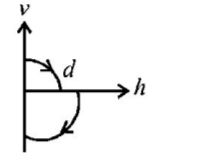
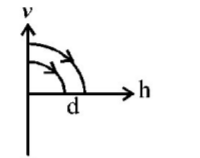
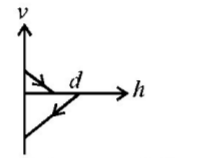
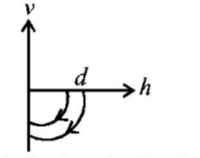
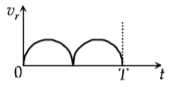
Two identical discs of same radius $$R$$ are rotating about their axes in opposite directions with the same constant angular speed $$\omega .$$ The discs are in the same horizontal plane. At time $$t=0,$$ the points $$P$$ and $$Q$$ are facing each other as shown in the figure. The relative speed between the two points $$P$$ and $$Q$$ is $${v_r}.$$ In one time period $$\left( T \right)$$ of rotation of the discs, $${v_r}$$ as a function of time is best represented by-
Two identical discs of same radius $$R$$ are rotating about their axes in opposite directions with the same constant angular speed $$\omega .$$ The discs are in the same horizontal plane. At time $$t=0,$$ the points $$P$$ and $$Q$$ are facing each other as shown in the figure. The relative speed between the two points $$P$$ and $$Q$$ is $${v_r}.$$ In one time period $$\left( T \right)$$ of rotation of the discs, $${v_r}$$ as a function of time is best represented by-

A.
B.

C.

D.

Answer :
Solution :
At $$t=0,$$ the relative velocity will be zero.
At $$t = \frac{T}{4},$$ the relative velocity will be maximum in magnitude.
At $$t = \frac{T}{2},$$ the relative velocity will be zero.
At $$t = \frac{3T}{4},$$ the relative velocity will be maximum in magnitude
At $$t=T,$$ the relative velocity again becomes zero.
At $$t=0,$$ the relative velocity will be zero.
At $$t = \frac{T}{4},$$ the relative velocity will be maximum in magnitude.
At $$t = \frac{T}{2},$$ the relative velocity will be zero.
At $$t = \frac{3T}{4},$$ the relative velocity will be maximum in magnitude
At $$t=T,$$ the relative velocity again becomes zero.