Question
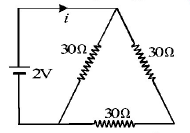
The current $$i$$ in the circuit (see Fig) is
The current $$i$$ in the circuit (see Fig) is
A.
$$\frac{1}{{45}}A$$
B.
$$\frac{1}{{15}}A$$
C.
$$\frac{1}{{10}}A$$
D.
$$\frac{1}{5}A$$
Answer :
$$\frac{1}{{10}}A$$
Solution :
$$BC$$ and $$AC$$ are in series
$$\therefore {R_{BCA}} = 30 + 30 = 60\Omega $$
Now $$BA$$ and $$DC$$ are in parallel.
$$\eqalign{ & \frac{1}{{{R_{eq}}}} = \frac{1}{{30}} + \frac{1}{{60}} = \frac{{90}}{{30 \times 60}} \cr & {R_{eq}} = 20\Omega ;\,\,\,\,\,\,\, \cr & V = IR \cr & \Rightarrow I = \frac{2}{{20}} = 0.1\,Amp \cr} $$
$$BC$$ and $$AC$$ are in series
$$\therefore {R_{BCA}} = 30 + 30 = 60\Omega $$
Now $$BA$$ and $$DC$$ are in parallel.
$$\eqalign{ & \frac{1}{{{R_{eq}}}} = \frac{1}{{30}} + \frac{1}{{60}} = \frac{{90}}{{30 \times 60}} \cr & {R_{eq}} = 20\Omega ;\,\,\,\,\,\,\, \cr & V = IR \cr & \Rightarrow I = \frac{2}{{20}} = 0.1\,Amp \cr} $$