Question
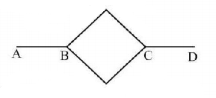
Six identical conducting rods are joined as shown in figure. Points $$A$$ and $$D$$ are maintained at $${200^ \circ }C$$ and $${20^ \circ }C$$ respectively. The temperature of junction $$B$$ will be
Six identical conducting rods are joined as shown in figure. Points $$A$$ and $$D$$ are maintained at $${200^ \circ }C$$ and $${20^ \circ }C$$ respectively. The temperature of junction $$B$$ will be
A.
$${120^ \circ }C$$
B.
$${100^ \circ }C$$
C.
$${140^ \circ }C$$
D.
$${80^ \circ }C$$
Answer :
$${140^ \circ }C$$
Solution :
Temperature difference between the end points $$A$$ and $$D = 200 - 20 = {180^ \circ }C$$
As the resistances for the three parts are equal, the temperature difference must be distributed equally in the three parts $$\left( {\frac{{180}}{3} = {{60}^ \circ }C} \right)$$
$$\therefore $$ Temperature of $$B = {200^ \circ }C - {60^ \circ } = {140^ \circ }C.$$
Temperature difference between the end points $$A$$ and $$D = 200 - 20 = {180^ \circ }C$$
As the resistances for the three parts are equal, the temperature difference must be distributed equally in the three parts $$\left( {\frac{{180}}{3} = {{60}^ \circ }C} \right)$$
$$\therefore $$ Temperature of $$B = {200^ \circ }C - {60^ \circ } = {140^ \circ }C.$$