Question

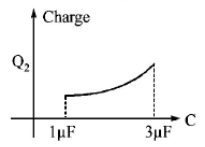
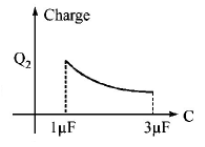
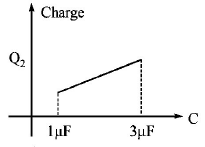
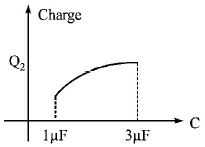
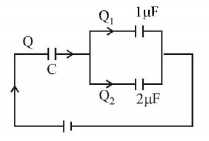
In the given circuit, charge $${Q_2}$$ on the $$2\mu F$$  capacitor changes as $$C$$ is varied from $$1\mu F$$  to $$3\mu F.$$  $${Q_2}$$ as a function of $$'C'$$ is given properly by: (figures are drawn schematically and are not to scale)
Capacitors and Dielectrics mcq question image

A. Capacitors and Dielectrics mcq option image
B. Capacitors and Dielectrics mcq option image
C. Capacitors and Dielectrics mcq option image
D. Capacitors and Dielectrics mcq option image  
Answer :   Capacitors and Dielectrics mcq option image
Solution :
Capacitors and Dielectrics mcq solution image
From figure, $${Q_2} = \frac{2}{{2 + 1}}Q = \frac{2}{3}Q$$
$$\eqalign{ & Q = E\left( {\frac{{C \times 3}}{{C + 3}}} \right) \cr & \therefore {Q_2} = \frac{2}{3}\left( {\frac{{3CE}}{{C + 3}}} \right) = \frac{{2CE}}{{C + 3}} \cr} $$
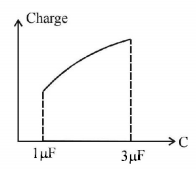
Therefore graph D correctly dipicts.
Capacitors and Dielectrics mcq solution image

Releted MCQ Question on
Electrostatics and Magnetism >> Capacitors and Dielectrics

Releted Question 1

A parallel plate capacitor of capacitance $$C$$ is connected to a battery and is charged to a potential difference $$V.$$ Another capacitor of capacitance $$2C$$ is similarly charged to a potential difference $$2V.$$ The charging battery is now disconnected and the capacitors are connected in parallel to each other in such a way that the positive terminal of one is connected to the negative terminal of the other. The final energy of the configuration is

A. zero
B. $$\frac{3}{2}C{V^2}$$
C. $$\frac{{25}}{6}C{V^2}$$
D. $$\frac{9}{2}C{V^2}$$
Releted Question 2

Two identical metal plates are given positive charges $${Q_1}$$ and $${Q_2}\left( { < {Q_1}} \right)$$   respectively. If they are now brought close together to form a parallel plate capacitor with capacitance $$C,$$ the potential difference between them is

A. $$\frac{{\left( {{Q_1} + {Q_2}} \right)}}{{2C}}$$
B. $$\frac{{\left( {{Q_1} + {Q_2}} \right)}}{C}$$
C. $$\frac{{\left( {{Q_1} - {Q_2}} \right)}}{C}$$
D. $$\frac{{\left( {{Q_1} - {Q_2}} \right)}}{{2C}}$$
Releted Question 3

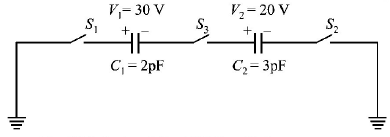
For the circuit shown in Figure, which of the following statements is true?
Capacitors and Dielectrics mcq question image

A. With $${S_1}$$ closed $${V_1} = 15\,V,{V_2} = 20\,V$$
B. With $${S_3}$$ closed $${V_1} = {V_2} = 25\,V$$
C. With $${S_1}$$ and $${S_2}$$ closed, $${V_1} = {V_2} = 0$$
D. With $${S_1}$$ and $${S_3}$$ closed, $${V_1} = 30\,V,{V_2} = 20\,V$$
Releted Question 4

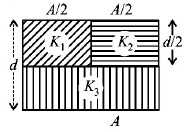
A parallel plate capacitor of area $$A,$$ plate separation $$d$$ and capacitance $$C$$ is filled with three different dielectric materials having dielectric constants $${k_1},{k_2}$$  and $${k_3}$$ as shown. If a single dielectric material is to be used to have the same capacitance $$C$$ in this capacitor, then its dielectric constant $$k$$ is given by
Capacitors and Dielectrics mcq question image

A. $$\frac{1}{K} = \frac{1}{{{K_1}}} + \frac{1}{{{K_2}}} + \frac{1}{{2{K_3}}}$$
B. $$\frac{1}{K} = \frac{1}{{{K_1} + {K_2}}} + \frac{1}{{2{K_3}}}$$
C. $$K = \frac{{{K_1}{K_2}}}{{{K_1} + {K_2}}} + 2{K_3}$$
D. $$K = {K_1} + {K_2} + 2{K_3}$$

Practice More Releted MCQ Question on
Capacitors and Dielectrics


Practice More MCQ Question on Physics Section