Question
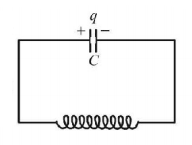
In an $$L-C$$ circuit shown in the figure, $$C = 1F,L = 4H.$$ At time $$t = 0,$$ charge in the capacitor is $$4C$$ and it is decreasing at a rate of $$\sqrt 5 \,C/s.$$ Choose the correct statements.
In an $$L-C$$ circuit shown in the figure, $$C = 1F,L = 4H.$$ At time $$t = 0,$$ charge in the capacitor is $$4C$$ and it is decreasing at a rate of $$\sqrt 5 \,C/s.$$ Choose the correct statements.
A.
maximum charge in the capacitor can be $$6C$$
B.
maximum charge in the capacitor can be $$8C$$
C.
charge in the capacitor will be maximum after time $$2{\sin ^{ - 1}}\left( {\frac{2}{3}} \right)\sec $$
D.
None of these
Answer :
maximum charge in the capacitor can be $$6C$$
Solution :
$$\eqalign{ & i = \sqrt 5 A \cr & \frac{{q_m^2}}{{2C}} = \frac{{{q^2}}}{{2C}} + \frac{1}{2}L{i^2} \Rightarrow {q_{\max }} = 6C \cr} $$
$$\eqalign{ & i = \sqrt 5 A \cr & \frac{{q_m^2}}{{2C}} = \frac{{{q^2}}}{{2C}} + \frac{1}{2}L{i^2} \Rightarrow {q_{\max }} = 6C \cr} $$