Question

In a photoelectric experiment, anode potential is plotted against plate current in figure. then
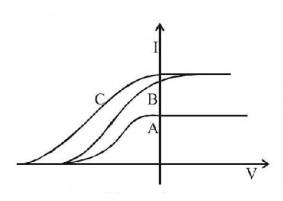
Dual Nature of Matter and Radiation mcq question image

A. $$A$$ and $$B$$ will have different intensities while $$B$$ and $$C$$ will have different frequencies
B. $$B$$ and $$C$$ will have different intensities while $$A$$ and $$C$$ will have different frequencies
C. $$A$$ and $$B$$ will have different intensities while $$A$$ and $$C$$ will have equal frequencies
D. $$B$$ and $$C$$ will have equal intensities while $$A$$ and $$B$$ will have same frequencies  
Answer :   $$B$$ and $$C$$ will have equal intensities while $$A$$ and $$B$$ will have same frequencies
Solution :
From the graph it is clear that $$A$$ and $$B$$ have the same stopping potential and therefore, the same frequency. Also, $$B$$ and $$C$$ have the same intensity.

Releted MCQ Question on
Modern Physics >> Dual Nature of Matter and Radiation

Releted Question 1

A particle of mass $$M$$ at rest decays into two particles of masses $${m_1}$$ and $${m_2},$$ having non-zero velocities. The ratio of the de Broglie wavelengths of the particles, $$\frac{{{\lambda _1}}}{{{\lambda _2}}},$$  is

A. $$\frac{{{m_1}}}{{{m_2}}}$$
B. $$\frac{{{m_2}}}{{{m_1}}}$$
C. 1.0
D. $$\frac{{\sqrt {{m_2}} }}{{\sqrt {{m_1}} }}$$
Releted Question 2

A proton has kinetic energy $$E = 100\,keV$$   which is equal to that of a photon. The wavelength of photon is $${\lambda _2}$$ and that of proton is $${\lambda _1}.$$ The ration of $$\frac{{{\lambda _2}}}{{{\lambda _1}}}$$  is proportional to

A. $${E^2}$$
B. $${E^{\frac{1}{2}}}$$
C. $${E^{ - 1}}$$
D. $${E^{ - \frac{1}{2}}}$$
Releted Question 3

A beam of electron is used in an YDSE experiment. The slit width is $$d.$$ When the velocity of electron is increased, then

A. no interference is observed
B. fringe width increases
C. fringe width decreases
D. fringe width remains same
Releted Question 4

Formation of covalent bonds in compounds exhibits

A. wave nature of electron
B. particle nature of electron
C. both wave and particle nature of electron
D. none of these

Practice More Releted MCQ Question on
Dual Nature of Matter and Radiation


Practice More MCQ Question on Physics Section