Question
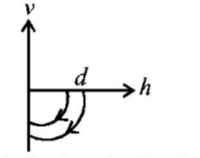
For a particle in uniform circular motion, the acceleration $${\vec a}$$ at a point $$P\left( {R,\theta } \right)$$ on the circle of radius $$R$$ is (Here $$\theta $$ is measured from the x-axis )
A.
$$ - \frac{{{v^2}}}{R}\cos \theta \,\hat i + \frac{{{v^2}}}{R}\sin \theta \,\hat j$$
B.
$$ - \frac{{{v^2}}}{R}\sin\theta \,\hat i + \frac{{{v^2}}}{R}\cos\theta \,\hat j$$
C.
$$ - \frac{{{v^2}}}{R}\cos \theta \,\hat i - \frac{{{v^2}}}{R}\sin \theta \,\hat j$$
D.
$$\frac{{{v^2}}}{R}\hat i + \frac{{{v^2}}}{R}\hat j$$
Answer :
$$ - \frac{{{v^2}}}{R}\cos \theta \,\hat i - \frac{{{v^2}}}{R}\sin \theta \,\hat j$$
Solution :
$$\eqalign{ & {\text{Clearly }}\vec a = {a_c}\cos \,\theta \left( { - \hat i} \right) + {a_c}\sin \,\theta \left( { - \hat j} \right) \cr & = \frac{{ - {v^2}}}{R}\cos \theta \hat i - \frac{{{v^2}}}{R}\sin \theta \hat j \cr} $$

$$\eqalign{ & {\text{Clearly }}\vec a = {a_c}\cos \,\theta \left( { - \hat i} \right) + {a_c}\sin \,\theta \left( { - \hat j} \right) \cr & = \frac{{ - {v^2}}}{R}\cos \theta \hat i - \frac{{{v^2}}}{R}\sin \theta \hat j \cr} $$