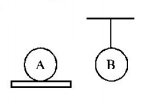
Consider two identical iron spheres , one which lie on a thermally insulating plate, while the other hangs from an insulatory thread. Equal amount of heat is supplied to the two spheres
A.
temperature of $$A$$ will be greater than $$B$$
B.
temperature of $$B$$ will be greater than $$A$$
C.
their temperature will be equal
D.
can’t be predicted
Answer :
temperature of $$B$$ will be greater than $$A$$
Solution :
Temperature of $$B$$ will be higher because, due to expansion centre of mass $$B$$ will comedown same heat is supplied but in $$B,$$ Potential energy is decreased therefore internal energy gain will be more.
Releted MCQ Question on Heat and Thermodynamics >> Conduction
Releted Question 1
A wall has two layers $$A$$ and $$B,$$ each made of different material. Both the layers have the same thickness. The thermal conductivity of the meterial of $$A$$ is twice that of $$B.$$ Under thermal equilibrium, the temperature difference across the wall is $${36^ \circ }C.$$ The temperature difference across the layer $$A$$ is
Three rods of identical cross - sectional area and made from the same metal from the sides of an isosceles triangle $$ABC,$$ right - angled at $$B.$$ The points $$A$$ and $$B$$ are maintained at temperatures $$T$$ and $$\left( {\sqrt 2 } \right)$$ $$T$$ respectively. In the steady state, the temperature of the point $$C$$ is $${T_c}.$$ Assuming that only heat conduction takes place, $$\frac{{{T_c}}}{T}$$ is
A.
$$\frac{1}{{2\left( {\sqrt 2 - 1} \right)}}$$
B.
$$\frac{3}{{\sqrt 2 + 1}}$$
C.
$$\frac{1}{{\sqrt 3 \left( {\sqrt 2 - 1} \right)}}$$
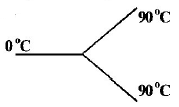
Three rods made of same material and having the same cross-section have been joined as shown in the figure. Each rod is of the same length. The left and right ends are kept at $${0^ \circ }C$$ and $${90^ \circ }C$$ respectively. The temperature of the junction of the three rods will be
Two identical rods are connected between two containers one of them is at $${100^ \circ }C$$ and another is at $${0^ \circ }C.$$ If rods are connected in parallel then the rate of melting of ice is $${q_1}\,gm/sec.$$ If they are connected in series then the rate is $${{q_2}}.$$ The ratio $$\frac{{{q_2}}}{{{q_1}}}$$ is