Question

An annular ring with inner and outer radii $${R_1}$$ and $${R_2}$$ is rolling without slipping with a uniform angular speed. The ratio of the forces experienced by the two particles situated on the inner and outer parts of the ring, $$\frac{{{F_1}}}{{{F_2}}}$$ is

A. $${\left( {\frac{{{R_1}}}{{{R_2}}}} \right)^2}$$
B. $$\frac{{{R_2}}}{{{R_1}}}$$
C. $$\frac{{{R_1}}}{{{R_2}}}$$  
D. $$1$$
Answer :   $$\frac{{{R_1}}}{{{R_2}}}$$
Solution :
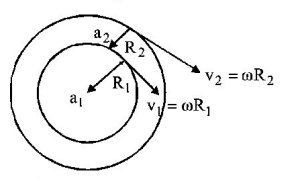
Rotational Motion mcq solution image
$$\eqalign{ & {a_1} = \frac{{v_1^2}}{{{R_1}}} = \frac{{{\omega ^2}R_1^2}}{{{R_1}}} = {\omega ^2}{R_1} \cr & {a_2} = \frac{{v_2^2}}{{{R_2}}} = {\omega ^2}{R_2} \cr} $$
Taking particle masses equal
$$\frac{{{F_1}}}{{{F_2}}} = \frac{{m{a_1}}}{{m{a_2}}} = \frac{{{a_1}}}{{{a_2}}} = \frac{{{R_1}}}{{{R_2}}}$$
Releted MCQ Question on
Basic Physics >> Rotational Motion

Releted Question 1

A thin circular ring of mass $$M$$ and radius $$r$$ is rotating about its axis with a constant angular velocity $$\omega ,$$  Two objects, each of mass $$m,$$  are attached gently to the opposite ends of a diameter of the ring. The wheel now rotates with an angular velocity-

A. $$\frac{{\omega M}}{{\left( {M + m} \right)}}$$
B. $$\frac{{\omega \left( {M - 2m} \right)}}{{\left( {M + 2m} \right)}}$$
C. $$\frac{{\omega M}}{{\left( {M + 2m} \right)}}$$
D. $$\frac{{\omega \left( {M + 2m} \right)}}{M}$$
Releted Question 2

Two point masses of $$0.3 \,kg$$  and $$0.7 \,kg$$  are fixed at the ends of a rod of length $$1.4 \,m$$  and of negligible mass. The rod is set rotating about an axis perpendicular to its length with a uniform angular speed. The point on the rod through which the axis should pass in order that the work required for rotation of the rod is minimum, is located at a distance of-

A. $$0.42 \,m$$  from mass of $$0.3 \,kg$$
B. $$0.70 \,m$$  from mass of $$0.7 \,kg$$
C. $$0.98 \,m$$  from mass of $$0.3 \,kg$$
D. $$0.98 \,m$$  from mass of $$0.7 \,kg$$
Releted Question 3

A smooth sphere $$A$$  is moving on a frictionless horizontal plane with angular speed $$\omega $$  and centre of mass velocity $$\upsilon .$$  It collides elastically and head on with an identical sphere $$B$$  at rest. Neglect friction everywhere. After the collision, their angular speeds are $${\omega _A}$$  and $${\omega _B}$$  respectively. Then-

A. $${\omega _A} < {\omega _B}$$
B. $${\omega _A} = {\omega _B}$$
C. $${\omega _A} = \omega $$
D. $${\omega _B} = \omega $$
Releted Question 4

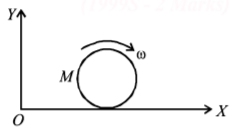
A disc of mass $$M$$  and radius $$R$$  is rolling with angular speed $$\omega $$  on a horizontal plane as shown in Figure. The magnitude of angular momentum of the disc about the origin $$O$$  is
Rotational Motion mcq question image

A. $$\left( {\frac{1}{2}} \right)M{R^2}\omega $$
B. $$M{R^2}\omega $$
C. $$\left( {\frac{3}{2}} \right)M{R^2}\omega $$
D. $$2M{R^2}\omega $$

Practice More Releted MCQ Question on
Rotational Motion


Practice More MCQ Question on Physics Section