A conducting disc of radius $$R$$ rotating about its axis with an angular velocity $$\omega .$$ Then the potential difference between the centre of the disc and its edge is (no magnetic field is present)
A.
zero
B.
$$\frac{{{m_e}{\omega ^2}{R^2}}}{{2e}}$$
C.
$$\frac{{{m_e}\omega {R^3}}}{{3e}}$$
D.
$$\frac{{e{m_e}\omega {R^2}}}{2}$$
Answer :
$$\frac{{{m_e}{\omega ^2}{R^2}}}{{2e}}$$
Solution :
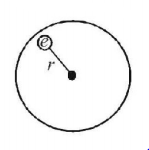
$$\eqalign{
& eE = {m_e}{\omega ^2}r \cr
& \Rightarrow \int E \,dr = \frac{{{m_e}{\omega ^2}}}{e}\int\limits_0^R {rdr} \cr
& \Rightarrow V = \frac{{{m_e}{\omega ^2}{R^2}}}{{2e}} \cr} $$
Releted MCQ Question on Electrostatics and Magnetism >> Electric Potential
Releted Question 1
If potential (in volts) in a region is expressed as $$V\left( {x,y,z} \right) = 6xy - y + 2yz,$$ electric field (in $$N/C$$ ) at point $$\left( {1,1,0} \right)$$ is
A.
$$ - \left( {3\hat i + 5\hat j + 3\hat k} \right)$$
B.
$$ - \left( {6\hat i + 5\hat j + 2\hat k} \right)$$
C.
$$ - \left( {2\hat i + 3\hat j + \hat k} \right)$$
D.
$$ - \left( {6\hat i + 9\hat j + \hat k} \right)$$
A conducting sphere of radius $$R$$ is given a charge $$Q.$$ The electric potential and the electric field at the centre of the sphere respectively are
A.
zero and $$\frac{Q}{{4\pi {\varepsilon _0}{R^2}}}$$
B.
$$\frac{Q}{{4\pi {\varepsilon _0}R}}$$ and zero
C.
$$\frac{Q}{{4\pi {\varepsilon _0}R}}{\text{and}}\frac{Q}{{4\pi {\varepsilon _0}{R^2}}}$$
In a region, the potential is represented by $$V\left( {x,y,z} \right) = 6x - 8xy - 8y + 6yz,$$ where $$V$$ is in volts and $$x,y,z$$ are in metres. The electric force experienced by a charge of $$2C$$ situated at point $$\left( {1,1,1} \right)$$ is
Four point charges $$ - Q, - q,2q$$ and $$2Q$$ are placed, one at each corner of the square. The relation between $$Q$$ and $$q$$ for which the potential at the centre of the square is zero, is