Question

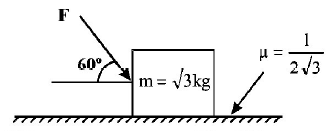
A block of mass 0.1 is held against a wall applying a horizontal force of $$5N$$ on the block. If the coefficient of friction between the block and the wall is 0.5, the magnitude of the frictional force acting on the block is :

A. $$2.5N$$
B. $$0.98N$$  
C. $$4.9N$$
D. $$0.49N$$
Answer :   $$0.98N$$
Solution :
Limiting frictional force, $${f_l} = {\mu _s}N = 0.5 \times 5 = 2.5N.$$      But force tending to produce relative motion is the weight $$\left( W \right)$$  of the block which is less than $${f_l.}$$ Therefore, the frictional force is equal to the weight, the magnitude of the frictional force $$f$$ has to balance the weight $$0.98 N$$  acting downwards.
Friction mcq solution image

Releted MCQ Question on
Basic Physics >> Friction

Releted Question 1

A block of mass $$2kg$$  rests on a rough inclined plane making an angle of $${30^ \circ }$$ with the horizontal. The coefficient of static friction between the block and the plane is 0.7. The frictional force on the block is

A. $$9.8N$$
B. $$0.7 \times 9.8 \times \sqrt 3 N$$
C. $$9.8 \times \sqrt 3 N$$
D. $$0.7 \times 9.8N$$
Releted Question 2

A block of mass 0.1 is held against a wall applying a horizontal force of $$5N$$ on the block. If the coefficient of friction between the block and the wall is 0.5, the magnitude of the frictional force acting on the block is :

A. $$2.5N$$
B. $$0.98N$$
C. $$4.9N$$
D. $$0.49N$$
Releted Question 3

An insect crawls up a hemispherical surface very slowly (see fig.). The coefficient of friction between the insect and the surface is $$\frac{1}{3}.$$ If the line joining the center of the hemispherical surface to the insect makes an angle $$\alpha $$ with the vertical, the maximum possible value of $$\alpha $$ is given by
Friction mcq question image

A. $$\cot \alpha = 3$$
B. $$\tan \alpha = 3$$
C. $$\sec \alpha = 3$$
D. $${\text{cosec}}\alpha = 3$$
Releted Question 4

What is the maximum value of the force $$F$$ such that the block shown in the arrangement, does not move?
Friction mcq question image

A. $$20\,N$$
B. $$10\,N$$
C. $$12\,N$$
D. $$15\,N$$

Practice More Releted MCQ Question on
Friction


Practice More MCQ Question on Physics Section